
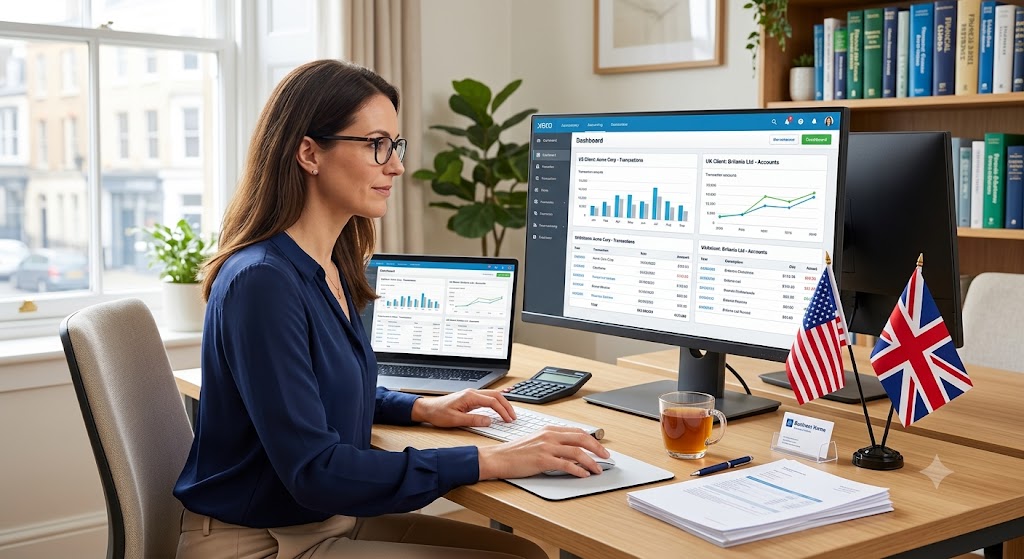
Businesses in the US and UK are increasingly moving their bookkeeping offshore — not to cut corners, but to get the same quality of financial management at a fraction of the cost of hiring locally. Remote bookkeeping has gone from a niche option to a mainstream choice for small and mid-sized companies on both sides of the Atlantic.
If you’re a US or UK business owner weighing whether remote bookkeeping is right for you, here’s what it actually involves, what it costs, and how to know if it’s a good fit.
What Is Remote Bookkeeping, Exactly?
Remote bookkeeping means your day-to-day financial records — transactions, reconciliations, payroll, reports — are managed by a bookkeeper or team working outside your office, usually in a different country or time zone. Everything happens through cloud accounting software like QuickBooks or Xero, shared drives, and regular video or written check-ins.
You don’t lose visibility or control. You gain a team that works around your books instead of around a 9-to-5 desk, often at a lower cost than local hires with the same level of expertise.
Why US and UK Businesses Are Choosing Remote Bookkeeping
1. Lower Cost Without Lower Quality
Hiring an in-house bookkeeper in the US or UK typically means a full-time salary, benefits, software licenses, and office overhead. Remote bookkeeping services let you access the same skill level — often accountants and bookkeepers trained in US GAAP or UK GAAP standards — without carrying that fixed cost.
2. Built for Cloud Accounting
Most remote bookkeeping teams work exclusively inside cloud platforms, which means your books are always current and accessible, whether you’re checking numbers from your office, home, or while traveling.
3. Scales With You
A remote team can flex up during busy seasons — think tax time, year-end close, or rapid growth — without the delay and cost of hiring and training someone new in-house.
4. Time Zone Coverage Can Work in Your Favor
Rather than being a drawback, time zone differences often mean your books get worked on overnight, so reports and reconciliations are ready when your business day starts.
What’s Included in a Remote Bookkeeping Service
A proper remote bookkeeping engagement typically covers the same ground as an in-house hire:
- Daily or weekly transaction recording — every sale, expense, and transfer categorized correctly.
- Bank and credit card reconciliation — matching your books to your actual accounts every month.
- Accounts payable and receivable — tracking what you owe and what’s owed to you.
- Monthly financial statements — profit and loss, balance sheet, and cash flow reports you can actually use to make decisions.
- Payroll support — for US and UK payroll rules respectively, including deductions and filings.
- Tax-ready books — organized records handed off cleanly to your accountant or tax preparer at year-end.
For businesses with more complex needs — like tax filing and compliance across multiple jurisdictions, or full-service bookkeeping and accounting — a remote team can often cover both under one engagement instead of juggling separate local providers.
US vs. UK: What’s Different
While the core bookkeeping principles are similar, there are a few country-specific details a good remote bookkeeping service should already understand:
- US businesses need bookkeeping aligned with IRS requirements, state-level sales tax rules (which vary significantly), and often 1099 contractor tracking.
- UK businesses need books that support HMRC filing requirements, VAT tracking where applicable, and Making Tax Digital (MTD) compliant record-keeping.
This is exactly why generic, one-size-fits-all bookkeeping support often falls short — the right provider should already be fluent in your specific regulatory environment, not learning it on your dime.
Is Remote Bookkeeping Secure?
This is usually the first concern business owners raise, and it’s a fair one. A properly run remote bookkeeping service should offer:
- Bank-level encrypted access to cloud accounting software, with no local storage of sensitive financial data
- Role-based permissions, so your remote team only sees what they need to do their job
- Confidentiality agreements as standard practice, not an optional add-on
- Regular, documented reporting so you always know what’s been done and when
Security shouldn’t be something you have to ask about — a legitimate provider will explain their process upfront, before you ever share access.
Common Questions About Remote Bookkeeping
Will I lose control over my finances?
No — if anything, most business owners report better visibility, since remote teams typically provide more structured, regular reporting than an in-house hire juggling multiple responsibilities.
What if I need to talk to someone in real time?
Reputable remote bookkeeping providers build in overlap hours or scheduled calls specifically so you’re never left waiting days for a response on something urgent.
How is this different from just using accounting software myself?
Software handles data entry and storage — it doesn’t catch miscategorized expenses, missed reconciliations, or the judgment calls that come from someone who actually understands bookkeeping. The software is the tool; the bookkeeper is the one making sure it’s used correctly.
Can a remote team handle both US and UK operations if I have both?
Yes, and this is actually one of the strongest cases for remote bookkeeping — a single provider familiar with both regulatory environments can keep your books consistent across borders, instead of managing two disconnected local providers.
Signs You’re Ready to Make the Switch
Remote bookkeeping tends to make the most sense when a few of these are true for your business:
- You’re spending hours each week on bookkeeping instead of running the business
- Your current setup can’t keep up with growing transaction volume
- You operate across the US and UK, or plan to expand internationally
- Tax season consistently feels chaotic instead of routine
If several of these sound familiar, it’s worth reading through the 5 signs your small business needs professional bookkeeping for a closer look at what disorganized books actually cost you over time.
Getting Started
Switching to remote bookkeeping doesn’t mean disrupting how your business runs day to day. A good provider starts with a review of your current books, gets everything current and accurate, then settles into a regular monthly rhythm that just works quietly in the background.
We support small and mid-sized businesses across the US, UK, and beyond with remote bookkeeping built around each country’s specific requirements. Book a free consultation and we’ll walk through exactly what your business needs.